Wednesday, January 26, 2011

The Kids Are All Right (2010) – directed by Lisa Cholodenko, written by Lisa Cholodenko and Stuart Blumberg


(I saw this in the middle of a very long train trip headed north. My boyfriend picked it out. We watched it on his laptop with separate headphones. The little boy next to us was watching Spider Man without headphones. I didn’t realize till just before we started watching it that the director was Lisa Cholodenko. I had seen two of her other movies High Art and Laurel Canyon and never would have guessed this was hers. We both laughed a lot. The movie was what you hope a Hollywood/ independent/ intelligent drama could be, but rarely is - incredibly good and not dumb. )


The Kids Are All Right is about a sort-of-happy family with two moms, one teenage son and one teenage daughter. The son becomes curious about his and his sister’s sperm donor (each of the moms gave birth but the same donor was used in both cases). Together, the kids contact the sperm donor. This is done secretly so that they don’t hurt their moms’ feelings. The Sperm donor (Paul played by Mark Ruffalo) is handsome and charming and is a soft-spoken ladies’ man. He owns a fancy restaurant, rides a motorcycle and dates young earthy women with tank tops. The kids aren’t sure if they like him or not but he starts coming to family dinner.

His presence slightly alters the dynamic of the family, in some ways really positively, empowering some family members, but also threatens the position for the more controlling mom (Nic played by Annette Bening). The more laid-back mom (Jules played by Julianne Moore) abruptly kisses Paul one day after he hires her to do some landscaping in his backyard. He kisses her back. As the days go on, there is much sex, and much understated bemusement and also troubled bemusement. After one sex incident Jules exclaims - “What is WRONG with me?!?”

It is more mundane subject matter than the mysteries-of-making-art and woman-rock-stars of Lisa Cholodenko’s other movies, High Art and Laurel Canyon (where there is much seductive yearning for things just-out-of-reach - like sex & mentoring from complicated women, or professional success in the arts), but all three movies are pretty straightforward narratives.

What makes The Kids Are All Right weirder and weightier is that it has something unusual to say. The movie builds and communicates the idea that marriage is a strong institution – like a pyramid.

After the affair is revealed to the whole family in a tumultuous instant, Paul and Jules have a private conversation on their cell phones. They are both outside because they live in California. He takes a breath and then takes a big leap (maybe the biggest of his life) - “Let’s do this. Let’s make a go of this.. now that it’s out in the open”.

Jules’ face moves in a spasm between incredulity and exasperation. I don’t remember what she said first - “I’m married!!!” or – “I’m a lesbian!!!”, but she hung up the phone after one of them. He had had no idea what he was up against. Neither did we really. We are used to marriages in movies being more like straw houses, and the people who blow them down - more like wolves.

With Jules’ declarations to Paul of commitments and sexual orientation (and everything that came before them in the movie), marriage suddenly looked like a heavy, intricate object – a thing complicated and structurally sound, with an agreed upon contract that allows construction and maintenance to take place over good and bad times, something difficult but that can ideally change shape, something that can’t be so easily be knocked down.

Paul got locked out of the house and it was hard not to feel for him – especially here in this movie where all the characters were complicated. The people inside the house were miserable, but they were warm and they would recover.

Wednesday, January 19, 2011

Exit Through the Gift Shop - movie by Banksy, a movie by Banksy, starring Thierry Guetta


(I rented this movie recently and didn’t watch it. Then I saw it lying on my friend Carl Wilson’s coffee table and asked to take it home. I managed to not watch it again but did pay some more overdue movie money. More recently, I ended up watching it one night as it came through my television from the internet while I sat on my bed with three friends. We all liked it more than we thought we would. I think. )


We start out in Exit through the Gift Shop with a lot of amateurish, rough and beautiful video footage. It has supposedly been shot by the star of the movie, a mustachioed and side-burned Frenchman living in California. The Frenchman is named Thierry. He is obsessed first with videotaping everything in his daily life and then with taping famous street artists at work. His obsession does not come with discipline but the years of it has lead to a hoard of unwatched videotapes, the casual neglect of his wife and children, and an introduction to the elusive British artist Banksy. Banksy is an artist who works anonymously and has an unconfirmed identity. In the movie we meet him but do not see his face.

Banksy (the more disciplined and purposeful obsessive) encourages Thierry to make a movie out of the videotapes. Thierry comes up with an old-fashioned avant-garde mess. After Banksy see the video, he encourages Thierry to leave the tapes with him and let him see what he could do with them. He encourages Thierry to take a break and maybe have an art show. As Thierry initiates a giant art show of his creation under the name Mr. Brainwash, Banksy makes Exit through the Gift Shop.

Exit through the Gift Shop is presented as a documentary. We see bits of Thierry’s sweet private life as shot by him. We are told stories about the narrative by Thierry and Banksy and also by the American street artist Shepard Fairey. We watch the pretty remarkable collected footage of street artists in action. When Banksy takes over the movie, we watch Thierry try to be an artist, to put his tag over other artists work, to put on his art show. We watch the public line up and buy his work.

I have read one movie critic who saw Exit through the Gift Shop as a straight up documentary and another, as a complete hoax. My default viewing position for most movies involves being comfortable being “a sucker” who is often mesmerized by story and flashing lights, as well as taking pleasure in my subjective position that often has no access (or admittedly, curiosity) about the “authentic” origin or intention of the work that I’m watching.

What helps even more in the case of Exit through the Gift Shop is that in all conceivable possibilities for how this movie was made, it is pretty easy to see that someone with a talented and thoughtful hand was making the most of their resources.

Imagine if the movie began with a room full of videotapes with the creator explaining that they had gathered hundreds of hours of footage of street art, shot by a mess of street-artist and their friends, and was now going to try to make something that the world should see.

Sometimes a lie wastes our time less and gives us more. Even if the movie is 100 percent true, Banksy’s nudging of Thierry to create an art show and leave him with the footage is a construction. A way of making art in the world from real things in the world. Pretty similar to what Banksy got himself famous for.

In Exit through the Gift Shop, we see a room full of videotapes, shot by one man, a man obsessed but, unfortunately, also overwhelmed. Here we demand order or crave it. Please, we think, make some sense of this man’s obsession. Free the disciplined artists caught by this fool.

I should mention that this fool has true gifts. In one scene as he sits in a backyard, looking at the camera and grasping for words to explain the feelings he had when he met Banksy for the first time – the performance is beautiful. Whether he is an actual street-art obsessive fan, or an amiable friend improvising, or France’s great actor – he nailed it.

The movie is accessible, clear, humorous, thought-provoking and entertaining. Or, to say it another way as one critic did, nothing new! But that is the wonderful thing about some great art – especially great street art. Communicating pain, politics and playfulness with clarity, lightness and charm should never be discounted as old-hat. It is always the hardest trick.

Wednesday, January 12, 2011

Somewhere (2010) - written and directed by Sophia Coppola


I saw Somewhere with my friend Sheila Heti in Los Angeles. I was curious about what she had to say about the movie and asked her if she could write about it on Back to the World.


Tuesday, January 11, 2011

Art things I thought about this year, that I can remember today, in order of remembrance.


1. The best movie I saw that I didn't write about this year - Rocky


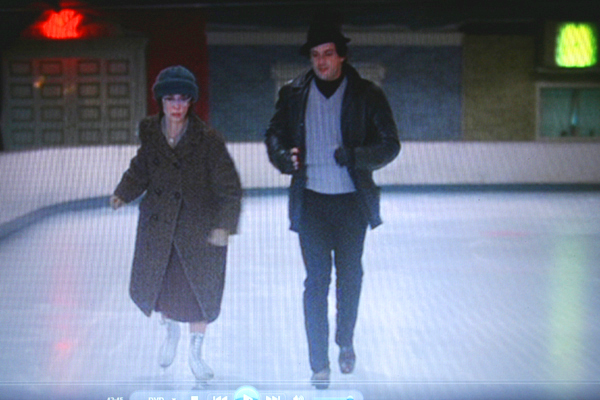
I had never seen any of the Rocky movies. It was recommended to me after a conversation about sports movies with my friend Lucas Rebick. I was surprised at how unfake the aesthetic was. It looked like Philedelphia in 1976.. and kind of like Toronto in 2010. I was surprised at how much I related to it. I related to Rocky and to all of the women he talks to.

"Hey Rocky" the loan shark's driver hollers out of a car window. "Yeah?" Rocky asks. The loan shark's driver - "You should take your girl to the zoo. I hear retarded people like the zoo." Rocky flinches, "Fuck you, man!" Rocky shouts back, "She ain't retarded, she's just shy."

2. The other best movie I saw this year and didn't write about - My Man Godfrey


My friend Gracie has a favourite romantic comedy from every decade. My Man Godfrey is her tops for the 30's (1936). Carole Lombard plays a rich socialite who falls in love with her butler. It was pretty interesting to see how rich people were portrayed as such silly and thoughtlessly cruel individuals (as in every situation, the beautiful, charming ones escape total condemnation). Rich people have enjoyed a much better and enduring reputation since all the communists were kicked out of Hollywood. It reminded me of how quickly things can change and how very long they can stay the same.

My favourite part came when the family needed to talk about money - the matriarch of the rich family looked horrified and cried “Money is dreadful! We can’t talk about money, it upsets Carlo!” (Carlo is the artist that they support). At this point Carlo turns away, towards the fire, upset and shuddering like an angel. Luckily, the cheese sandwiches come in just as things are about to get awk-ward.

3. Thick of It

I really couldn't get enough of this British TV show from 2005 about the inner workings of the modern British Government. Sample text (if I am remembering correctly) - "Terry, do you know why they call him the Fucker?"

"Is it .. is it.. because he's.. a bit of a fucker?"

4. Work of Art: America's Next Great Artist and what people wrote about it.

This new reality TV show premiered in the summer. Contestants, from across the U.S., compete in an art competition with a jury of professional critics and artists. It was just like any other reality TV show. It was strange. And people wrote about it.


Art Fag City covered it like white on rice, Lynn Crosbie had some good points for the artists and Jerry Saltz (an art critic who was a judge on the show) wrote an article for each episode after first participating in and then watching the episodes. Jerry Saltz's articles were, hands down, the best art to come out of the show. The articles were written to an audience that included the show’s participants, viewers and art-insiders. He wrote about the art, judging the art and judging himself judging the art. It was strange and good.

Some art-insider critiques of the show sounded an awful lot like a reversal of the old art-outsider stereotype - “my kid could paint that”. The equivalent turns out to be - “my friend down the street from me, in Brooklyn, could paint that a lot better”. Sucks to be on the outside.

Though there didn’t feel like there was too much at stake (America’s next great artist-wise), the beginning of some hilariously awkward public conversations (involving critics, artists and audience) about what art is felt stupid-smart, meaningful and full of potential.

The only “unreality” part was at the end when there were only three contestants left. One would get the bank and the others nothing. Maybe it’s just my world, but every artist I know would have been more than happy to split a hundred thousand dollars 3 ways and then gone about their business. But I guess reality TV without winners or losers is just the NFB.

5. Websites about videos

I know about these two websites, Ryeberg Curated Video and 2 Pause: Freezing Music Video Culture, because I contributed to them. But they're both really interesting and I'm sure there's a lot more of these websites out there - websites that are figuring out how to talk about or organize the massive amounts of videos out there. Ryeberg has contributors write short essays on Youtube videos and 2 Pause collects interesting music videos and puts them into categories like these: Lo/No Budget (that is where I am and this nice one from Antony and Boy George), Netherclips, Stop Motion, Electric Cinema (I didn't watch them all but found this nice one from Foals and Chris Sweeney) and French Wave. I would like to see the categories that everyone has for their videos.

6. Artists Using and Sharing

I really liked that Erykah Badu made this video by borrowing the idea from Matt and Kim. She credits them in the beginning of the video. The structure of her video is identical, but the feel and meaning are completely different and more to my interests. The borrowing and added art reminds me of this article about Jeff Wall from a while ago.

Olaf Breuning's work (consisting of performance based art video) has always looked really interesting but I assumed that he, like a lot of artists, didn't put all of his work on-line. I only just saw one of his videos recently when Jon Davies screened it at the Cinecycle. It was great. Then I went home, looked him up and discovered that all of his videos are available on his website. Thank you Jon Davies for reminding me of Olaf Breuning and thank you Olaf Breuning for sharing. SO much better that way.

7. Moral/ art lessons from popular music videos

LCD Soundsystem and Spike Jonze reminds us that drunk people, whom are often beautiful and fun, can also be really fucking annoying. The video, featuring the band being abused by people dressed as pandas, is as good as Spike Jonze's videos always are. And Lady Gaga and Beyoncé remind you again that it's a bad idea to disrespect the people who serve your food. And Kanye West, who likes a lot of the same things I like ( naked ladies, revolution, ballet, Beyoncé, Takashi Murakami) reminds us to take paintings seriously.

8. Luc Tuyman's painting Turtle

I really loved this painting this year, from 2007.

I also really love this painting from Brad Phillips.

9. A brief LIFE OF A CRAPHEAD performance I saw at Double Double Land

The performances from Toronto’s LIFE OF A CRAPHEAD (Amy C. Lam and Jon McCurley) feel so good on your brain. They go right to the part that understands but doesn't share with the other parts of your brain – the parts that could explain what is happening. But then those parts start understanding something else and then, somehow, every part of your brain is being massaged by a fire in-the-know and then it is over. It can feel like good drugs, but really, it's more like spinach.


10. SUM: Forty Tales from the Afterlives by David Eagleman

David Eagleman, a neuroscientist, wrote this strange book comprised of brief scenarios of the afterlife. More about life than after.

11. Missing Objects

Is it too late for a really, really long Arrested Developement movie?

Also, I would like an audio book of Jack Hitt's articles. I would buy two. While we wait, we can read his Mighty White of You: Racial preferences color America's oldest skulls and bones and listen to his Act 5, the 52 minute long audio documentary about a group of prisoners at the Missouri Eastern Correctional Center who are rehearsing and staging a production of Hamlet. It's great.

12. Golden Gate Park in San Francisco

Nice work William Hammond Hall and John McLaren.

Tuesday, December 7, 2010

The Ring (2002) – directed by Gore Verbinski, based on the the movie by Hideo Nakata, the novel by Kôji Suzuki & the Japanese ghost story Banchō Saray


(My friend Duane Wall likes horror movies but none of his friends do. So every year on his birthday, he selects a horror movie and then invites his friends over to watch the movie. Last year was Bruce MacDonald’s Pontypool and the year before was David Cronenberg’s The Fly. This year it was the American version of The Ring. The movie’s title was kept secret until it started, when five minutes in someone shouted, What is this called!?)


The Ring is a horror mystery about an unmarked videotape that somehow kills the people who watch it. The short video work features black and white footage of disturbing and seemingly unrelated scenes. One of the characters, before being properly impressed by the power of the video, expressed his opinion that it just looked like a bad student art video. (His respect deepens quickly enough). After a person watches the video, they receive a mysterious phone call and then die seven days later with a look of horror on their faces. That is, until an investigative journalist (played by Naomi Watts) starts poking around.

The movie also stars a self-sufficient child, a man afraid of monogamy and fatherhood, horses, a cluster of worn and futuristic apartment buildings and a good old-fashioned romantic/creepy island.

The atmosphere of the movie was seductive and its themes pleasurable: “don’t eat that apple!” verses “knowledge will set you free!”, peace-making verses resourceful military strategizing, the goodness of a small community island versus an impenetrable microcosm that is intolerant of foreigners and misfortune, metaphors of scapegoats and viruses becoming interchangeable.

There are lots of fun things to say about the movie but they all involve the ending. I never mind hearing the full details of a plot before I see something, but for the kind of movie whose primary success is derived from its surprises – maybe it is best to not give away its secrets.

Later on, after watching the movie, my mind wandered to the plot points and tried to connect the ways certain elements fit together. When I could fit them together with logic, I would feel a spooky pleasure. When I couldn’t, and the only end point was “supernatural mystery,” I felt as disappointed as a kid being told that babies come from heaven. We all know the real answers can be a lot crazier than the made-up ones.

It made me think of an article I had read awhile ago about David Cronenberg. He talked about being sent scripts from Hollywood that involved the supernatural and how insulting or disappointing that was since he, as an atheist, was philosophically opposed to those views. He assumed that anyone who watched his movies could see that.

I loved the image that comes to mind with this scenerio - confused studio executives trying to understand both the moral integrity of David Cronenberg and the difference between The Fly and the script for the demon/god vehicle Constantine while Cronenberg looks on patiently disappointed by what to him was obvious - his horror movies are entirely of this world.

Postscript: I also enjoyed the movie Constantine.


Wednesday, November 24, 2010

The September Issue (2009) - starring Anna Wintour, directed by R.J. Cutler


(This always looked pretty compelling on the video store shelf but was always out when I would think to pick it up. The day it was in, it looked a little less compelling. I remembered, once I had it in my hand, that I had not had such luck with movies about fashion. But it still looked compelling enough.)


The September Issue is a documentary about the all-powerful and greatly feared editor of Vogue magazine, Anna Wintour. Anna Wintour is credited with creating a “fashion bible” through Vogue, jump-starting the careers of young designers, centralizing the power of the fashion industry in a circle around her, striking fear into the hearts of subordinates, reigniting the fur industry, and ending grunge.

The movie covers the creation, which Anna Wintour oversees, of the 2007 September issue of Vogue – the bible part. Here, Anna Wintour is a woman who loathes small talk, is self-aware of the relation fashion has to the rest of the world, works incredibly hard, tries to not get mad when others don’t work as hard, uses words more than facial expressions to communicate, is incapable of following her grown child’s every move without adoring and irrepressible love in her eyes, reacts to things she dislikes with silence and reacts to things she likes with genuine praise. She is not primarily negative and she is not a trash-talker.

When I was watching this, I couldn’t remember if this is what our culture thinks a bitch is or if this is a very generous portrait of a woman and an industry.

Sure, you feel for the people who quiver in her uncomforting presence, but you also hope for a bit more integrity of character. If fashion really is an intersection between art and commerce, we think mostly of the commerce part in these moments. We also see that Anna Wintour does believe (or hopes) that fashion is meaningful and that art is involved. Her relief is obvious when people around her seem more preoccupied with the art than with winning her favour for obvious and easy reward. Her relief is most notable here in relation to Grace Coddington, Vogue’s creative director. The working relationship between these two women forms the poetic spine of the movie.

Anna Wintour’s immensity of character was the subject of another movie - fictionalized in The Devil Wears Prada, a movie based on a book of the same name that was written by one of her former assistants.

For The September Issue, the man allowed in to document the real Anna Wintour is named R.J. Cutler. R.J. Cutler’s production company is called “Actual Reality Pictures” (quite a tall claim in these early 21st century times, but anyway). Based on the production company’s name, and the other projects listed on their website, it appears as though R.J. Cutler is a man who thinks that reality TV is not real and that he is the man who will make it real. Though this just means his is a old-school documentary filmmaker whose weakness will be in forgetting his own subjectivity and impact on his subject (or his subject’s impact on him).

All in all, not a bad fit for a real person who was referred to fictionally as “The Devil” right there in the title of a Hollywood movie starring Meryl Streep. How much worse could it be in an old-school documentary? Not worse, though also not great. And clearly Anna Wintour is a subject worthy of something monumental.

If I was Anna Wintour, I too might have invited R.J. Cutler of “Actual Reality Pictures” to take my picture after I was fictionalized as “The Devil”. Had “The Devil” not happened, maybe someone from the production company “Not So Much Actual Reality But Still Kind Of Reality and Killer for Deeper Truth About Humans” would have gained access and made a complicated mountain out of this mountain of a subject. There is still time.

Tuesday, November 16, 2010

Uncle Boonmee Who Can Recall His Past Lives (2010) – written and directed by Apichatpong Weerasethakul


(I didn’t know too much about “Uncle Boonmee Who Can Recall His Past Lives” but I liked the title and I had half-noticed that the word “art” kept being used in relation to it. Somehow the “art” was not mentioned in either a flattering or negative way, just a descriptive way. “Art” can mean a lot of things, like that the characters will have a lot of feelings or that it will be either pretty unpleasant or extremely pleasant to watch or that the movie will be going after something difficult to catch. Very quickly into “Uncle Boonmee Who Can Recall His Past Lives”, it was clear that the “art” in this case related to the words “intuitive” and “unusual” - and also maybe “going after something difficult to catch.”)


Uncle Boonmee Who Can Recall His Past Lives is made up of separate stories that happen in various times and places. They are connected literally and/or metaphorically by the title Uncle Boonmee Who Can Recall His Past Lives.

Servants carry a princess through the jungle. It looks pretty unpleasant to carry a princess through the jungle. But also, it looks maybe a little bit erotic. The princess has a face darkened with a scar or birthmark. The party comes to rest at the base of waterfall. There, the princess tries to convince herself that intimacy with one of her servants is love. It doesn’t work. She sends the servant away and collapses alone by the water’s edge. She cries and voices out-loud her longing for pure and white skin and also for true love. At this point of despair a catfish begins to talk to her from the surface of the water. “Are you a ghost?” she asks the catfish. “No, I am a catfish”, the catfish says. She eventually enters the water with abandon and has sex with the catfish. Something is being promised to her but we are not sure what it is.

There is a big bull tied to a tree. We stay with the bull for a while in the half-dark. We start to relate to him like any character in a movie. He makes a noise and we sort of know what it means. It seems kind of awful for such a big creature to be tied, by the neck, to a tree in the middle of a field. But maybe it’s ok. In a quick moment he yanks his rope free and lightly runs his giant body to the outskirts of the jungle and then stops there for a bit. Eventually, a man finds him. The man gently leads the bull back towards the field.

Uncle Boonmee has a farm where he grows tamarind and sweet and sour honey. Uncle Boonmee’s kidneys are failing and he thinks he will die in two days. He wonders if it’s because of his karma. “I was bad to the communists”, he says during his dialysis treatment. On the porch, he eats dinner with his sister-in-law and her friend when it is dark outside.

At the dinner table, the ghost of his long-dead wife appears. His ghost-wife looks like a normal wife, but younger. Then a monkey-ghost, the transformed body of his long-lost son, comes to sit down. The monkey-ghost looks amazing. He explains that he was trying to capture something with his camera, on the outskirts of the jungle, when he mated with a monkey-ghost and became a monkey-ghost himself. He explains that now the creatures and ghosts can sense Uncle Boonmee’s illness and are coming closer.

They all sit together at the table quietly. There is very little small talk. The whole movie feels like this, as though every living thing is cautiously acting and speaking as simply as possible in order to make room for some understanding.

Eventually, the wife-ghost and the monkey-ghost are shown photo albums of the years they have missed.

Later on, we are shown still photos too. The photos we see were taken in a field during the day: of a monkey-man being led out of the jungle with a rope tied around his neck by a soldier in camouflage. These photos are the strange cousins of horrific photos we are familiar with from history, but here, in this movie, we see and think about the photos in a different way. Which is good because they are difficult to understand in a logical way.

There is another photo of soldiers, laughing and smiling – it seems like something bad is happening to the monkey-man. Then there is a last photo of the soldiers and the monkey-man posing together, the rope still tied around his neck, everyone smiling. Maybe it is OK we think, but probably it really isn’t.

Later, back in real life at Uncle Boonmee's farm, Uncle Boonmee, his ghost-wife, his sister-in-law and her friend start on a journey away from the farm and into a field and down into the jungle. The ghost-wife is leading. Uncle Boonmee is trying to make the best sense he can out of his good and bad deeds before he dies. This journey is the best he can do now. They go deeper and enter a cave that looks like the frozen stalactites of centuries-old falling water. They travel deep down into the cave, Uncle Boonmee moving slowly. At the very bottom, they find a tiny pool of albino catfish. This is where Uncle Boonmee lies down.

The movie is not an exploration of filmmaker Apichatpong Weerasethakul’s wild ideas. It is him trying wildly to make sense of the best and worst of life’s absurdities by expanding and examining them with intuitive logic.

If you are adept at intuitive logic (and with navigating the trauma that was the 20th century) his film will be as clear and seductive as early dusk. It will be as practical and as heartbreaking as any story about injustice, hope and despair could possibly be. Funny too. And beautiful.