Showing posts with label revolution. Show all posts

Tuesday, March 15, 2011

The Baader Meinhof Complex (2008) - directed by Uli Edel, written and produced by Bernd Eichinger, based on the book by Stefan Aust, based on the extr


(I saw this at a cine club in Mexico City. The club is run by the director Jorge Aguilera. I had been brought in by my photographer friend Lee Towndrow. I was told beforehand that the movies for viewing were chosen “somewhat democratically”. After arriving, Jorge put out a number of movies on the floor. The one I wanted to see most was The Baader Meinhof Complex. I tried to secretly will the group to choose that one, and also tried not to. The Baader Meinhof Complex was somewhat democratically selected. In the end, the two and a half hour movie wasn’t such a big hit.


It was a strange time to watch a movie about a Western terrorist group while the Middle East was on fire with predominately peaceful protests against oppressive governments; protests ignited by the suicide of Mohamed Bouazizi, a Tunisian fruit seller who set himself on fire after police confiscated his cart.

The next night, a few of us ended up gathering again and we watched Jacques Tati’s beautiful Play Time. A good movie to see when you are in someone else’s big city.)
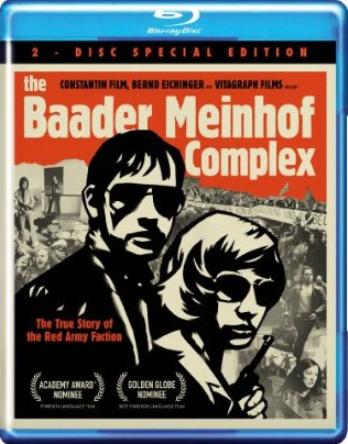


The Baader Meinhof Complex tells the story of the leftist terrorist group The Red Army Faction that was formed in Germany in 1970. The group consisted mostly of young activists but also by a well-known journalist. They were known to the public at the Baader-Meinhof Group.

The movie is so careful to include all of the details of their history that there is not so much room for the stuff in between ... like tension. Maybe a faithfulness to the details was somewhat necessary with this highly contentious history, but it probably would have functioned better in serial form on television.

The movie is good propaganda against glamour and violence. The physical exhaustion of watching so much in an endless stream really does work to create an aversion ... um, for those who don’t already have an aversion.

The particulars of the group stayed with me. Visually, the anarchy and cool of the German men and women stood out hilariously at a Jordan Fatah training camp as they proclaimed their shared fight with their Palestinian comrades.

At the camp, their volatility stood out too. They conspire against one of their own - telling the Palestinian camp leaders that this newly ostracized member is an Israeli spy. The camp leaders, seeing through the in-fighting, compassionately offer the “Israeli spy” help getting home. The Palestinian camp leaders seemed centuries older.

But the strongest particular with the Baader Meinhof Group is that they are all part of the generation of young Germans born right around or just after Hitler’s reign. They are one generation removed and the inheritors of Germany’s horrific legacy. I would guess that what some of these people had was a complex view of civilian responsibility.

A lot of us think that we wouldn’t have been complacent as Germans in Hitler’s Germany but what these people might know better than us is how abstract these problems can look like at the time and how painfully clear it all is in hindsight.

They might have been acutely aware of how ambiguous that space is in-between tolerance and complacency - especially in the present when the facts and understanding haven’t yet settled. This might be where they were coming from, in 1970, when it was becoming somewhat clear that pretty horrible things were going on in the world.

Maybe with some more distance and time, another attempt can be made to tell a story about this very old and universal problem of civilian responsibility and civilian power.


Tuesday, July 13, 2010

Sweet Sweetback's Baadasssss Song (1971) - directed by and starring Melvin Van Peebles


(I had rented Sweet Sweetback's Baadasssss Song and Twilight #2 at the video store. My friend Carl Wilson called just as Twilight #2 ended to see if I wanted to watch a movie. So Carl and I watched Sweet Sweetback's Baadasssss Song. Neither of us had seen it before. We asked each other a lot of questions about the plot throughout the movie. If you get the DVD, don’t miss “The Making of…” documentary. Melvin Van Peebles is a pretty easy man to listen to. )


A young black orphan is taken in by a lot of black women in an arty brothel… or a sexy art performance space. The young orphan quickly becomes a man and is then named Sweetback – I think because he is such a good lover. Sweetback doesn’t talk much… or at all. He is a good performer and is also very passive. The arty space looks oddly familiar to me – as though this movie wasn’t made that long ago or made from that far away.

Some white cops enter and watch the end of a performance that Sweetback is part of – they watch from a distance. They are digging it – everyone is. The show is about a dyke’s dream of becoming a man. Two women, one in drag with a beard and a dildo, and one with bride of Frankenstein hair, perform a loving courtship in the middle of the space’s red-carpeted room. The audience, seated on chairs, circles them intimately. A tall man, in a pale blue fairy godmother gown, tells us that even dykes have dreams. With some distraction tricks and lighting effects, the dyke’s dream comes true and the woman in drag becomes Sweetback the man, with a real beard and a real penis. The loving courtship is then consummated.

After the show, the cops ask the boss of the space, Beetle, if Beetle can give them “one of his boys” for them to take downtown. On account of a recent murder, the cops want to bring in some suspects so they look good to their superiors. We’ll bring him right back, they say. In exchange, the cops offer continued good relations and a bit of dope. Beetle considers, then suddenly sees the camera and glares at the camera’s intrusion – or glares at whoever the camera is supposed to be.

Sweetback is so well-liked by everyone that when the cops take him to an abandoned field (with another “suspect” they pick up) Sweetback is freed of his handcuffs by one of the cops. “Oh sorry about that Sweetback” the cops says to Sweetback, noticing eventually that Sweetback is getting jerked around as they hit the man who does not yet “look like a sniper” whom Sweetback is handcuffed to. The cop frees Sweetback and then returns to beating the other man. Sweetback looks out to the distance for a while and, after an incredibly long moment, eventually turns and hits both the cops with his half open handcuffs. Everything is stilled, the movie framing only Sweetback as the only man standing. After another moment, Sweetback returns to beating the cops at his feet. After this, hell breaks loose.

The black community is internally torn by Sweetback’s actions and is also turned upside down while cops look for Sweetback. People are angry at Sweetback for causing all this trouble, but excited, too, that Sweetback is still alive. The longer Sweetback escapes the reach of the cops, the more excited people get. During this time, there is some self-protective love-making that Sweetback engages in with ex-girlfriends, racist bikers and non-communicative hippies.

Also during this time, a lot of conversations take place - between Sweetback and people offering to help Sweetback, between Sweetback and people who are not offering to help Sweetback, conversations between the cops and the press, the cops and the cops, between the religious minister and the people, the religious minister and Sweetback - between the cops and Sweetback’s friends. During most of these conversations, the talkers talk right into the camera, the camera standing in for the “listener” or for Sweetback - since Sweetback is most often the one being talked at. It creates the effect of feeling, as a member of the movie audience, that you are in the position of the person who is being talked at. The movie could have been called “Things People Have Said To Me (Sweetback) and To You!”

The effect works so effortlessly within the traditionally structured narrative that I didn’t even notice it at first. It’s pretty impressive to stretch the rules of a traditional narrative to include the audience in this way without actually breaking the narrative. It is especially impressive when the effect is both subtle and effective, where the silence of the main character most clearly mimics the silence of an audience.

It also works to create empathy for almost all of the characters – for the audience to be put in this position of being yelled at, or turned away, or treated as a villain or an insider or as a friend.

It is not the most obvious choice to make a movie about a revolution where the main revolutionary never speaks, but it sure makes for a sound revolution. "Run Sweetback, Run!" the band Earth, Wind & Fire sing/ scream at Sweetback over and over again from the musical score as Sweetback makes his way out of the city, across the fields and into the desert. If Sweetback saves himself and makes it to Mexico, he might one day return.

Thursday, May 6, 2010

At Five in the Afternoon (2003) - written and directed by Samira Makhmalbaf


(I watched Samira Makhmalbaf’s third feature length movie at home recently on my breaking-down television. Samira Makhmalbaf’s first feature, “The Apple”, is one of my favourites. It's set in Iran and is about twin sisters who are physically let out of the locked gate of their home for the first time in their eleven years by a calm and persistent social worker. The girls roam around the neighbourhood together like delighted aliens. The father who had kept them behind the gate is shown simply as a religious man with a blind wife who was doing what he thought was best. “At Five in the Afternoon” also involves two female characters who live with a religious father figure. The father here is also simply doing what he thinks is best. He is an old man and the girls are women. The father, again, wants to protect them, but he is running out of locations - struggling to find a place for them all where “God still lives”. There is no gate – no house and the woman are not prisoners. They live as refugees moving from “ruins” to “ruins” with a horse drawn cart in a devastated Afghanistan. Like “The Apple”, it is an incredibly pleasurable movie.)


Apart from the chores of finding food, water and shelter, the main character Nogreh stands most frequently at a back doorway between a religious meeting place and a city street. She slips her sky blue burqa behind her head like a superhero cape and replaces her modest shoes with well worn high heels and heads off to a school she secretly attends with girls who have less strict fathers than hers. At her school, there are “elections” to see which girl should be “president”. Nogreh has entered the race. She spends a great deal of the movie asking others and herself how change can happen in her country, how a woman like her could become president. She wants to see the speeches that successful presidential candidates in other countries wrote – “the speeches that made people vote for them”. Her questions are searching and practical, she is starting from the beginning.

There is one scene where Nogreh descends down an outdoor staircase with her high heels, her sky blue cape and sun umbrella. Behind her are ruins where her father rests. She stops ten steps above a French soldier standing alone at the bottom of the ruins. Nogreh’s friend, Poet, bikes up and begins to act as translator. The French soldier is told by Poet that Nogreh is Afghanistan’s future president. The French soldier immediately brings his body to attention and salutes Nogreh with sincere respect.

I understand the soldier, I understand that if you are in a foreign country (or even in your own neighborhood), it is often hard to know what is what. It looks like the French solider is both prepared to understand this is a game and prepared to understand that this is true. How could he possibly know for sure? It is hard even for the girl, whose narrative this is, to know what is possible. But he responds with conviction and respect. The soldier and Nogreh have entered into a situation that is either a game or a new beginning - none of us are sure which.

When Shakespeare wrote "All the world's a stage / And all the men and women merely players” in 1599, theatrical stages were in fewer numbers and in more collectively agreed upon locations than presently. Though teasing with “reality”, it was clearly a metaphor.

In 2010, the world is literally very often a stage – the stage part comes in and out of focus in random locations all around the world with the help of tiny video cameras and big, cheap ones. It is now more likely to be true that the sand box we are sitting in or the war zone we are negotiating can literally turn into a stage before you know it.

Shakespeare’s line is still an effective metaphor because though the world is often a stage, it is not always. And though sometimes we are pretending, we are not always. We know both things are possible, at the same time or alternatively, and depending on where one is standing. We can see the metaphor and/or the literal, the play fighting and/or the war, the posturing and/or the effective stabs at action.

There are some great movie makers who are smart about these co-existing perspectives: Agnes Varda, Charlie Kaufman, Ben Stiller with “Tropic Thunder". But Samira Makhmalbaf knows better than anyone how to make art while the world's random and occasionally painfully real theatrical stages coming in and out of focus. She is a genius at saying tangible and concrete things that shift freely between "the stage" and "the reality" - and at knowing how true to life this looks now.

Even woven into the heart of Samira Makhmalbaf's narrative is the hopeful and searching question - could these poetic metaphors of empowerment also be true? Her main character, Nogreh, asks herself: Am I playing or is this real? The answer, of course, is "Yes".

Tuesday, February 2, 2010

Avatar (2010)


(I went to see this with my friend Julia Rosenberg who is an independent film producer. She was game and looked pretty great in the 3d glasses. I tried to take our picture with my cell phone but you could only see 2 small white dots on a black screen. We saw it on a Friday nigh in one of the biggest movie houses in downtown Toronto. We saw it with maybe about 400 other people in an IMAX theatre.)


The first time I saw a movie at an IMAX theatre, I was nine. It was Christmas and it was Texas and I was with a lot of adults. I had on sneakers and a purple mini skirt. The adults bought tickets for a visual spectacle called “Earth” maybe, or something like that. We sat up close. The movie was about how we as humans were polluting the planet.

They showed images taken from above the earth to show how factories changed the colour of lakes and rivers. They showed images taken from ground to show how the sky was changing from everyday pollution. They showed people at work throwing their lunch waste in bins and then they followed their lunch waste to the dumps. They showed property development, clear cutting, forest fires, animals fleeing, deserts being created and rivers running dry. I remember there was a narrator with a soothing female voice. Half way through, I vomited. I was cleaned up in a bathroom by one of the adults and then taken back in to the horror. As I watched the rest of the movie, shivering, everything changed.

For me, the movie was an emergency newscast. But of course, when the lights came up, the adults around me (who had more experience with emergency newscasts) had to decide what we were going to have for dinner. This confusion is always part of our lives. After that movie, I always remembered how we didn’t go to war that day, how sunsets looked a little more sinister to me, and how much was my fault.

If I had, instead, seen "Avatar" in an IMAX theatre when I was nine, I think I probably would not have thrown up. I probably would have been excited about all the other 3D movies to come, and relaxed in knowing that there were seriously bad intentioned bad guys out there who weren’t me or my people. All we had to do was stop them, or maybe even they would have the good sense to stop themselves after watching this movie, and then we would get the flying horses back.

The moment “Avatar” ended and the credits started to roll, laughter sprung quietly from various corners of the huge audience. There was no applause, but also no booing. We had to give our glasses back on our way out. Mine had become filthy somehow by the end of the movie. The next day, I had no feeling about any of it but I did start to wonder when white men will begin to openly complain, along with the rest of us, about having to play stereotypes of themselves in fiction.