Showing posts with label avant-garde. Show all posts

Wednesday, January 19, 2011

Exit Through the Gift Shop - movie by Banksy, a movie by Banksy, starring Thierry Guetta


(I rented this movie recently and didn’t watch it. Then I saw it lying on my friend Carl Wilson’s coffee table and asked to take it home. I managed to not watch it again but did pay some more overdue movie money. More recently, I ended up watching it one night as it came through my television from the internet while I sat on my bed with three friends. We all liked it more than we thought we would. I think. )
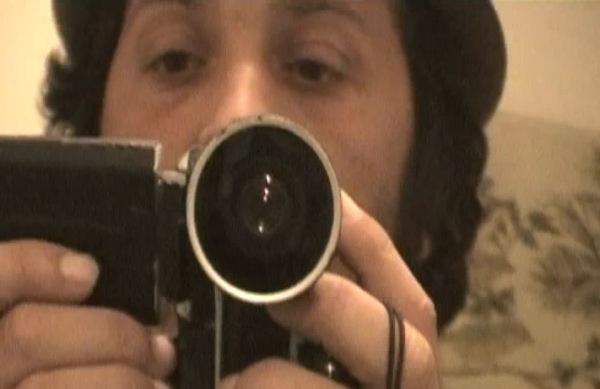


We start out in Exit through the Gift Shop with a lot of amateurish, rough and beautiful video footage. It has supposedly been shot by the star of the movie, a mustachioed and side-burned Frenchman living in California. The Frenchman is named Thierry. He is obsessed first with videotaping everything in his daily life and then with taping famous street artists at work. His obsession does not come with discipline but the years of it has lead to a hoard of unwatched videotapes, the casual neglect of his wife and children, and an introduction to the elusive British artist Banksy. Banksy is an artist who works anonymously and has an unconfirmed identity. In the movie we meet him but do not see his face.

Banksy (the more disciplined and purposeful obsessive) encourages Thierry to make a movie out of the videotapes. Thierry comes up with an old-fashioned avant-garde mess. After Banksy see the video, he encourages Thierry to leave the tapes with him and let him see what he could do with them. He encourages Thierry to take a break and maybe have an art show. As Thierry initiates a giant art show of his creation under the name Mr. Brainwash, Banksy makes Exit through the Gift Shop.

Exit through the Gift Shop is presented as a documentary. We see bits of Thierry’s sweet private life as shot by him. We are told stories about the narrative by Thierry and Banksy and also by the American street artist Shepard Fairey. We watch the pretty remarkable collected footage of street artists in action. When Banksy takes over the movie, we watch Thierry try to be an artist, to put his tag over other artists work, to put on his art show. We watch the public line up and buy his work.

I have read one movie critic who saw Exit through the Gift Shop as a straight up documentary and another, as a complete hoax. My default viewing position for most movies involves being comfortable being “a sucker” who is often mesmerized by story and flashing lights, as well as taking pleasure in my subjective position that often has no access (or admittedly, curiosity) about the “authentic” origin or intention of the work that I’m watching.

What helps even more in the case of Exit through the Gift Shop is that in all conceivable possibilities for how this movie was made, it is pretty easy to see that someone with a talented and thoughtful hand was making the most of their resources.

Imagine if the movie began with a room full of videotapes with the creator explaining that they had gathered hundreds of hours of footage of street art, shot by a mess of street-artist and their friends, and was now going to try to make something that the world should see.

Sometimes a lie wastes our time less and gives us more. Even if the movie is 100 percent true, Banksy’s nudging of Thierry to create an art show and leave him with the footage is a construction. A way of making art in the world from real things in the world. Pretty similar to what Banksy got himself famous for.

In Exit through the Gift Shop, we see a room full of videotapes, shot by one man, a man obsessed but, unfortunately, also overwhelmed. Here we demand order or crave it. Please, we think, make some sense of this man’s obsession. Free the disciplined artists caught by this fool.

I should mention that this fool has true gifts. In one scene as he sits in a backyard, looking at the camera and grasping for words to explain the feelings he had when he met Banksy for the first time – the performance is beautiful. Whether he is an actual street-art obsessive fan, or an amiable friend improvising, or France’s great actor – he nailed it.

The movie is accessible, clear, humorous, thought-provoking and entertaining. Or, to say it another way as one critic did, nothing new! But that is the wonderful thing about some great art – especially great street art. Communicating pain, politics and playfulness with clarity, lightness and charm should never be discounted as old-hat. It is always the hardest trick.

Monday, March 1, 2010

Yayoi Kusama: I Love Me (2009) - Directed by Takako Matsumoto


(I saw this in a theatre at the Jewish Community Center in Toronto. It was part of Reel Artists – a small festival of movies about artists. My artist friend Shary Boyle had invited me to go. We sat together on a small row of seats. When one person moved in their seat - everybody moved in their seats.)


The documentary follows Yayoi Kusama around for a few years. Most of the time, she seems to be 77. Kusama is a successful artist who lives in Japan. When the office of the Emperor of Japan called, they asked if she would prefer being described as an abstract artist or an avant-garde artist when she received the Emperor's award for her contributions to the world - she prefers avant-garde. As blogger Oh, Carlos. says of her work - “Installation art done right. Even the most art-tarded person could walk into one of her rooms and feel something.”

It wasn’t till I arrived at the community center that I remembered having torn out an image of hers from an art magazine a long time ago – an advertisement from an art show without the title of the individual work. At the time, I worked and lived alone in a bachelor apartment. I didn’t have so many art friends back then. I always hated having little pictures of any kind around when I worked, but this image was helpful somehow. I taped it up above my sink.


Takako Matsumoto, the director of "Yayoi Kusama: I Love Me," stood up before the screening and explained that critical reviews of Kusama's work focus too much on her mental health issues, and that she had worked to avoid that problem. Unfortunately, the movie that followed also avoided a rigorous investigation into the more nuanced successes of Kusama’s work.

Mainly, Matsumoto's documentary follows Kusama around watching her paint and listening to her talk about her success. I can understand how this happened, she is a really compelling person to watch (I could barely focus on anyone else’s face in the movie and it’s not just because of her multi-coloured wigs or her cold stare that warmly reminded me of my grandmother.)

So by default, this movie ends up being a casual study of narcissism. It reminded me of that old joke - “what came first? The 60s avant-garde or the narcissist?” Kusama does not attempt to cover up her own narcissism in any way so it was not uncomfortable to witness as she seems to get very little pleasure from anything else. Her self-championing and self-branding seem integral to the success she has received from the art world and are by no means unusual or out of place there.

Avant-garde art started out as an understanding that radically new or politically critical work was often misunderstood and rejected by established art institutions. So along with this concept were contempt for conformity, commercial success and suspicion of established art institutions - though things got complicated. Around the 60s and 70s, many self described avant-garde artists weren't as afraid of being in the museums (as they became more embraced by them) as they were of being derivative. Creating something wholly original in the world became a primary goal.

There is a hope within this form that an individual’s originality will create the next part of the solid line of art history or human history. In retrospect, it is hard not to see all these individual attempts at originality forming the small new branches on a tree rather than a solid time-based line pointing to the future. The younger generation of artists are still interested in creating something new, but I think that they are not as afraid of being a part of the world in order to do this. Hopefully that means that some of them will succeed in talking about the heart of the tree rather than reaching as far away from the trunk as possible.

And though Kusama shares this interest of being wholly unique (and profits from the critical and commercial success that being "wholly unique" now occasional provides), her work betrays a longing for the whole of the world and a longing to escape this rigorous individuality and its isolating narcissism. Her art often shows a space filled with a seemingly infinite number of repeated and harmoniously similar objects (occasionally referred to in her titles as “souls” or “fireflies".) It’s unusual to have images that allow you to think warmly and pleasurably of the infinite universe without including a fear of it. The effect is closer to a unity that is complicated and freeing rather than fascist. Maybe this is why she is still making work that looks so contemporary and not like the work from 40 years ago. New is still good right?

At one point while painting, Kusama talks about being surprised when she had first sold a painting for 1.6 million dollars. “Did that make you happy?” the documentarian asks from behind the camera. “Yes, it was nice” Kusama responds, “It is nicer to make a new world… but it is Ok.”