Showing posts with label reality TV. Show all posts

Wednesday, June 8, 2011

Reframing Africa - curated by Jean-Marie Teno

by Margaux Williamson

Last night at the Images Festival, I saw "Reframing Africa 1: Representation or Reality?".

Boy, what a relief it was to see such good work. It's rare to have all of the short works  in a curated program be this full of life, this compelling - to have the story they form together be both so direct and so complicated. It was curated by the African filmmaker Jean-Marie Teno and included the work of 5 other African filmmakers.


Now that I trust Jean-Marie Teno completely,  I can recommend a conversation between him and Deanna Bowen today, April 5th,  at the Gladstone from 3 pm to 4 as well as his second curated program of short works that's screening tonight (April 5 from 9 pm to 11 pm) at Jackman Hall (AGO) - "Reframing Africa 2: Perspectives in Mambety's Footsteps.

Wednesday, January 19, 2011

Exit Through the Gift Shop - movie by Banksy, a movie by Banksy, starring Thierry Guetta


(I rented this movie recently and didn’t watch it. Then I saw it lying on my friend Carl Wilson’s coffee table and asked to take it home. I managed to not watch it again but did pay some more overdue movie money. More recently, I ended up watching it one night as it came through my television from the internet while I sat on my bed with three friends. We all liked it more than we thought we would. I think. )


We start out in Exit through the Gift Shop with a lot of amateurish, rough and beautiful video footage. It has supposedly been shot by the star of the movie, a mustachioed and side-burned Frenchman living in California. The Frenchman is named Thierry. He is obsessed first with videotaping everything in his daily life and then with taping famous street artists at work. His obsession does not come with discipline but the years of it has lead to a hoard of unwatched videotapes, the casual neglect of his wife and children, and an introduction to the elusive British artist Banksy. Banksy is an artist who works anonymously and has an unconfirmed identity. In the movie we meet him but do not see his face.

Banksy (the more disciplined and purposeful obsessive) encourages Thierry to make a movie out of the videotapes. Thierry comes up with an old-fashioned avant-garde mess. After Banksy see the video, he encourages Thierry to leave the tapes with him and let him see what he could do with them. He encourages Thierry to take a break and maybe have an art show. As Thierry initiates a giant art show of his creation under the name Mr. Brainwash, Banksy makes Exit through the Gift Shop.

Exit through the Gift Shop is presented as a documentary. We see bits of Thierry’s sweet private life as shot by him. We are told stories about the narrative by Thierry and Banksy and also by the American street artist Shepard Fairey. We watch the pretty remarkable collected footage of street artists in action. When Banksy takes over the movie, we watch Thierry try to be an artist, to put his tag over other artists work, to put on his art show. We watch the public line up and buy his work.

I have read one movie critic who saw Exit through the Gift Shop as a straight up documentary and another, as a complete hoax. My default viewing position for most movies involves being comfortable being “a sucker” who is often mesmerized by story and flashing lights, as well as taking pleasure in my subjective position that often has no access (or admittedly, curiosity) about the “authentic” origin or intention of the work that I’m watching.

What helps even more in the case of Exit through the Gift Shop is that in all conceivable possibilities for how this movie was made, it is pretty easy to see that someone with a talented and thoughtful hand was making the most of their resources.

Imagine if the movie began with a room full of videotapes with the creator explaining that they had gathered hundreds of hours of footage of street art, shot by a mess of street-artist and their friends, and was now going to try to make something that the world should see.

Sometimes a lie wastes our time less and gives us more. Even if the movie is 100 percent true, Banksy’s nudging of Thierry to create an art show and leave him with the footage is a construction. A way of making art in the world from real things in the world. Pretty similar to what Banksy got himself famous for.

In Exit through the Gift Shop, we see a room full of videotapes, shot by one man, a man obsessed but, unfortunately, also overwhelmed. Here we demand order or crave it. Please, we think, make some sense of this man’s obsession. Free the disciplined artists caught by this fool.

I should mention that this fool has true gifts. In one scene as he sits in a backyard, looking at the camera and grasping for words to explain the feelings he had when he met Banksy for the first time – the performance is beautiful. Whether he is an actual street-art obsessive fan, or an amiable friend improvising, or France’s great actor – he nailed it.

The movie is accessible, clear, humorous, thought-provoking and entertaining. Or, to say it another way as one critic did, nothing new! But that is the wonderful thing about some great art – especially great street art. Communicating pain, politics and playfulness with clarity, lightness and charm should never be discounted as old-hat. It is always the hardest trick.

Tuesday, January 11, 2011

Art things I thought about this year, that I can remember today, in order of remembrance.


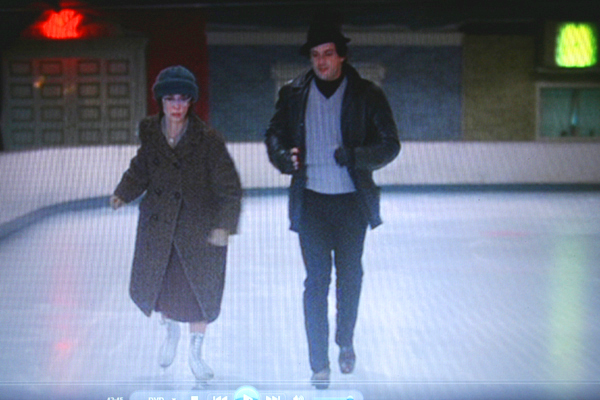
1. The best movie I saw that I didn't write about this year - Rocky


I had never seen any of the Rocky movies. It was recommended to me after a conversation about sports movies with my friend Lucas Rebick. I was surprised at how unfake the aesthetic was. It looked like Philedelphia in 1976.. and kind of like Toronto in 2010. I was surprised at how much I related to it. I related to Rocky and to all of the women he talks to.

"Hey Rocky" the loan shark's driver hollers out of a car window. "Yeah?" Rocky asks. The loan shark's driver - "You should take your girl to the zoo. I hear retarded people like the zoo." Rocky flinches, "Fuck you, man!" Rocky shouts back, "She ain't retarded, she's just shy."

2. The other best movie I saw this year and didn't write about - My Man Godfrey


My friend Gracie has a favourite romantic comedy from every decade. My Man Godfrey is her tops for the 30's (1936). Carole Lombard plays a rich socialite who falls in love with her butler. It was pretty interesting to see how rich people were portrayed as such silly and thoughtlessly cruel individuals (as in every situation, the beautiful, charming ones escape total condemnation). Rich people have enjoyed a much better and enduring reputation since all the communists were kicked out of Hollywood. It reminded me of how quickly things can change and how very long they can stay the same.

My favourite part came when the family needed to talk about money - the matriarch of the rich family looked horrified and cried “Money is dreadful! We can’t talk about money, it upsets Carlo!” (Carlo is the artist that they support). At this point Carlo turns away, towards the fire, upset and shuddering like an angel. Luckily, the cheese sandwiches come in just as things are about to get awk-ward.

3. Thick of It

I really couldn't get enough of this British TV show from 2005 about the inner workings of the modern British Government. Sample text (if I am remembering correctly) - "Terry, do you know why they call him the Fucker?"

"Is it .. is it.. because he's.. a bit of a fucker?"

4. Work of Art: America's Next Great Artist and what people wrote about it.

This new reality TV show premiered in the summer. Contestants, from across the U.S., compete in an art competition with a jury of professional critics and artists. It was just like any other reality TV show. It was strange. And people wrote about it.


Art Fag City covered it like white on rice, Lynn Crosbie had some good points for the artists and Jerry Saltz (an art critic who was a judge on the show) wrote an article for each episode after first participating in and then watching the episodes. Jerry Saltz's articles were, hands down, the best art to come out of the show. The articles were written to an audience that included the show’s participants, viewers and art-insiders. He wrote about the art, judging the art and judging himself judging the art. It was strange and good.

Some art-insider critiques of the show sounded an awful lot like a reversal of the old art-outsider stereotype - “my kid could paint that”. The equivalent turns out to be - “my friend down the street from me, in Brooklyn, could paint that a lot better”. Sucks to be on the outside.

Though there didn’t feel like there was too much at stake (America’s next great artist-wise), the beginning of some hilariously awkward public conversations (involving critics, artists and audience) about what art is felt stupid-smart, meaningful and full of potential.

The only “unreality” part was at the end when there were only three contestants left. One would get the bank and the others nothing. Maybe it’s just my world, but every artist I know would have been more than happy to split a hundred thousand dollars 3 ways and then gone about their business. But I guess reality TV without winners or losers is just the NFB.

5. Websites about videos

I know about these two websites, Ryeberg Curated Video and 2 Pause: Freezing Music Video Culture, because I contributed to them. But they're both really interesting and I'm sure there's a lot more of these websites out there - websites that are figuring out how to talk about or organize the massive amounts of videos out there. Ryeberg has contributors write short essays on Youtube videos and 2 Pause collects interesting music videos and puts them into categories like these: Lo/No Budget (that is where I am and this nice one from Antony and Boy George), Netherclips, Stop Motion, Electric Cinema (I didn't watch them all but found this nice one from Foals and Chris Sweeney) and French Wave. I would like to see the categories that everyone has for their videos.

6. Artists Using and Sharing

I really liked that Erykah Badu made this video by borrowing the idea from Matt and Kim. She credits them in the beginning of the video. The structure of her video is identical, but the feel and meaning are completely different and more to my interests. The borrowing and added art reminds me of this article about Jeff Wall from a while ago.

Olaf Breuning's work (consisting of performance based art video) has always looked really interesting but I assumed that he, like a lot of artists, didn't put all of his work on-line. I only just saw one of his videos recently when Jon Davies screened it at the Cinecycle. It was great. Then I went home, looked him up and discovered that all of his videos are available on his website. Thank you Jon Davies for reminding me of Olaf Breuning and thank you Olaf Breuning for sharing. SO much better that way.

7. Moral/ art lessons from popular music videos

LCD Soundsystem and Spike Jonze reminds us that drunk people, whom are often beautiful and fun, can also be really fucking annoying. The video, featuring the band being abused by people dressed as pandas, is as good as Spike Jonze's videos always are. And Lady Gaga and Beyoncé remind you again that it's a bad idea to disrespect the people who serve your food. And Kanye West, who likes a lot of the same things I like ( naked ladies, revolution, ballet, Beyoncé, Takashi Murakami) reminds us to take paintings seriously.

8. Luc Tuyman's painting Turtle

I really loved this painting this year, from 2007.

I also really love this painting from Brad Phillips.

9. A brief LIFE OF A CRAPHEAD performance I saw at Double Double Land

The performances from Toronto’s LIFE OF A CRAPHEAD (Amy C. Lam and Jon McCurley) feel so good on your brain. They go right to the part that understands but doesn't share with the other parts of your brain – the parts that could explain what is happening. But then those parts start understanding something else and then, somehow, every part of your brain is being massaged by a fire in-the-know and then it is over. It can feel like good drugs, but really, it's more like spinach.


10. SUM: Forty Tales from the Afterlives by David Eagleman

David Eagleman, a neuroscientist, wrote this strange book comprised of brief scenarios of the afterlife. More about life than after.

11. Missing Objects

Is it too late for a really, really long Arrested Developement movie?

Also, I would like an audio book of Jack Hitt's articles. I would buy two. While we wait, we can read his Mighty White of You: Racial preferences color America's oldest skulls and bones and listen to his Act 5, the 52 minute long audio documentary about a group of prisoners at the Missouri Eastern Correctional Center who are rehearsing and staging a production of Hamlet. It's great.

12. Golden Gate Park in San Francisco

Nice work William Hammond Hall and John McLaren.

Wednesday, November 24, 2010

The September Issue (2009) - starring Anna Wintour, directed by R.J. Cutler


(This always looked pretty compelling on the video store shelf but was always out when I would think to pick it up. The day it was in, it looked a little less compelling. I remembered, once I had it in my hand, that I had not had such luck with movies about fashion. But it still looked compelling enough.)


The September Issue is a documentary about the all-powerful and greatly feared editor of Vogue magazine, Anna Wintour. Anna Wintour is credited with creating a “fashion bible” through Vogue, jump-starting the careers of young designers, centralizing the power of the fashion industry in a circle around her, striking fear into the hearts of subordinates, reigniting the fur industry, and ending grunge.

The movie covers the creation, which Anna Wintour oversees, of the 2007 September issue of Vogue – the bible part. Here, Anna Wintour is a woman who loathes small talk, is self-aware of the relation fashion has to the rest of the world, works incredibly hard, tries to not get mad when others don’t work as hard, uses words more than facial expressions to communicate, is incapable of following her grown child’s every move without adoring and irrepressible love in her eyes, reacts to things she dislikes with silence and reacts to things she likes with genuine praise. She is not primarily negative and she is not a trash-talker.

When I was watching this, I couldn’t remember if this is what our culture thinks a bitch is or if this is a very generous portrait of a woman and an industry.

Sure, you feel for the people who quiver in her uncomforting presence, but you also hope for a bit more integrity of character. If fashion really is an intersection between art and commerce, we think mostly of the commerce part in these moments. We also see that Anna Wintour does believe (or hopes) that fashion is meaningful and that art is involved. Her relief is obvious when people around her seem more preoccupied with the art than with winning her favour for obvious and easy reward. Her relief is most notable here in relation to Grace Coddington, Vogue’s creative director. The working relationship between these two women forms the poetic spine of the movie.

Anna Wintour’s immensity of character was the subject of another movie - fictionalized in The Devil Wears Prada, a movie based on a book of the same name that was written by one of her former assistants.

For The September Issue, the man allowed in to document the real Anna Wintour is named R.J. Cutler. R.J. Cutler’s production company is called “Actual Reality Pictures” (quite a tall claim in these early 21st century times, but anyway). Based on the production company’s name, and the other projects listed on their website, it appears as though R.J. Cutler is a man who thinks that reality TV is not real and that he is the man who will make it real. Though this just means his is a old-school documentary filmmaker whose weakness will be in forgetting his own subjectivity and impact on his subject (or his subject’s impact on him).

All in all, not a bad fit for a real person who was referred to fictionally as “The Devil” right there in the title of a Hollywood movie starring Meryl Streep. How much worse could it be in an old-school documentary? Not worse, though also not great. And clearly Anna Wintour is a subject worthy of something monumental.

If I was Anna Wintour, I too might have invited R.J. Cutler of “Actual Reality Pictures” to take my picture after I was fictionalized as “The Devil”. Had “The Devil” not happened, maybe someone from the production company “Not So Much Actual Reality But Still Kind Of Reality and Killer for Deeper Truth About Humans” would have gained access and made a complicated mountain out of this mountain of a subject. There is still time.

Tuesday, November 2, 2010

The Social Network (2010) - based on a book by Ben Mezrich, screenplay by Aaron Sorkin & directed by David Fincher


(I went to this at a big movie house with Misha Glouberman and Jon Davies. I was pretty excited to see it. After the screening, we realized our friend Carl Wilson was sitting behind us. We all sat around talking as the credits rolled. Jon was surprised at how the movie didn’t stupidly go on and on explaining what Facebook is - like you often see in some movies about blogs or in that 1998 Tom Hanks and Meg Ryan vehicle that explains what email is. One of us suggested that maybe it was easier with Facebook to find the actual number of those in the know so that they could count the potential audience and see that they didn’t have to worry about it so much.)


The Social Network falls into one of my favourite genres: The nearly-present-just-recently-past historical drama - like Oliver Stone’s W. (about George W. Bush while he was still in office) or Stephen Frears’ The Queen (about The Queen). One of the good side effects of telling a story still so tied to the present is that it becomes less plausible to make the main protagonist a hero or a god with all the banal evidence still in plain view. But in any case, seeing the more life-size protagonists and daily banalities blown up as big as cinema screen is just as surreal as watching a bunch of gods portrayed in a realistic setting. We are not missing the “awe” factor. The Queen in The Queen is freakishly life-size while the story, both weirder and more familiar than normal, remains a healthy contender for a new kind of epicness.

There’s always a bit of complaining when turning a section of life into a bio-pic. Primarily the complaints involve accusations that elements of the truth were sacrificed for the romance of the story, but it’s not just Hollywood that turns things into big stories – our brains do it all the time too, even with our own boring lives. Personal media framing websites like Facebook and Youtube help to speed this up. Luckily, most of us know better than to completely trust the history books or our own memories. Now we just have to learn how not to always trust our own eyes.

The Social Network is framed by a typical boy-losses-girl-then-says-internally-I’ll-show-you!-then-becomes-important-though-never-forgets-the-girl kind of story. The boy is a Harvard undergrad, Mark Zuckerberg. He is the founder of Facebook. Most of the movie is set at Harvard. Harvard looks more excitingly foreboding than Hollywood here with all of its old-school and discreet power. The girl goes to a different university and we can’t quite remember her name. Because the movie is framed this way, the narrative tension and resolution rests on this simple arc and not on the other details of the complicated Facebook founding story. This is good news because it allows the Facebook story to be ever-complicated and truthfully unresolved while we still get the delicious full sandwich of a tidy story.

The untidy part is up for interpretation. There are the Winkevosses - handsome, gentlemanly identical twin brothers. They are Harvard elites who are only a touch sinister. They seem to represent not only each other, but many of their kind that we can't see. They believe that they have gotten their idea of a Harvard-only networking site swiped from under their noses by Mark Zuckerberg. They probably have, but it's hard to worry about them too much. Some of us are not accustomed to this much privilege and it seems more wondrous and strange than what they think they got cheated out of.

After Mark Zuckerberg gets Facebook up and running, we're happy for him when he becomes friends with Sean Parker (founder of Napster). We imagine that it feels great to find a colleague who is just as obsessed by the same kind of creation as he is. We imagine that they have a lot to talk about. In this movie, this is when Mark Zuckerberg looks happiest, though the creators seem to credit the excitement to cheap glamour more than creative interest.

It is hard not to take pleasure here in a representation of the older generation's frequent blindness over Internet matters, as though the kids are talking about a pretend world that doesn't really matter. The freedom of not being seen feels thrilling here.

And it’s hard to get too upset with Mark Zuckerberg when he royally and legally cheats his best friend/ business partner, the sweetheart Eduardo Saverin, out of his fair share of the business. We’re not sure if this was one more move on top of a series of fights between the two friends, or if it was just a callous business decision. But we have known since the beginning of the movie that Mark Zuckerberg has always been a bit of a jerk, even when he was just a best friend that was a nobody. This last move should not have been too much of a surprise to Eduardo Saverin.

We feel for anyone who has been unpleasantly suprised by a friend even when they shouldn't have been surprised (Eduardo Saverin and Mark Zuckerberg included). It happens to the best of us - especially when we are young and patient and become friends with people who might not be such a good fit. Nevertheless, we have some optimism that these two may re-friend each other some day (in the imagined post-movie movie-life of this particular movie).

Wednesday, October 6, 2010

Town Bloody Hall (1971 – 1979) - event produced by Shirley Broughton & Theatre for Ideas, filmed by DA Pennebaker & later edited by Chris Hegedus.


(My friends Sheila Heti and Lucas Rebick saw “Town Bloody Hall” over the weekend. Sheila called on Monday to see if I wanted to watch it, she said I would like it. My TV was broken, so I walked over in the rain and sat down on a couch that only had one leg. Sheila used to have a small tv, but now it is very big.)


It’s April 30, 1971 and we’re at New York City’s Town Hall. There are a few tables on stage with white tablecloths and several microphones. There is one podium off to the side. We watch the people on stage and in the audience settle into their seats. People seem excited.

I am not one to normally be nostalgic for the past, but man (!) does everyone look good. Everyone looks totally different from one another and there is an absence of polar fleece (not to be invented until 1979). Is that a fox around Germaine Greer’s glamorous shoulders? Jill Johnston looks like the fun member of the Ramones. Norman Mailer (who is the only man on stage) looks like Norman Mailer.

The other heavyweights, along with the three just mentioned, are Jacqueline Ceballos and Diana Trilling. Susan Sontag and other famous writers fill the seats in the audience closest to the stage and will soon ask some hilarious questions. Norman Mailer has just published The Prisoner of Sex, and Germain Greer, The Female Eunuch.

The event was put together by the Theatre for Ideas and here are the rules of the evening: Norman Mailer is the moderator, all five panelists are allowed 10 minutes to make a speech at the podium, Norman Mailer is to cut people off when they have gone over their time and also to then ask them a question (in response to their speech) that they are not allowed to answer till the end of the evening.

All five panelists are incredibly intelligent and have interesting, complicated opinions, especially Germain Greer who is like an inexplicably calm lightening rod. Each say totally different things from the others. Most of them can barely look at each other as they argue their position with force or respond to each other’s question - except for Jacqueline Ceballos who seems to be enjoying herself immensely as an on-stage spectator.

The audience seems ready to burst with their wavering reactions to what is being said – and occasionally does. One man from the audience starts screaming incoherently about “humans” as he wrestles to put on his jacket and storms out. Later, another woman bursts in angrily yelling about not getting in because there were no seats left. She is escorted back out.

This structure set up by Theatre for Ideas creates really great theatre. For instance, having Norman Mailer function literally as the authoritarian for the event both mimics life and also reveals its inherent absurdity. If the event had been set up as an ideal political structure for a panel discussion on women’s liberation (i.e. the man not in charge) the “art” wouldn’t be there to bring out the tension and humor or the playful and painful metaphors. This choice shows Theatre for Ideas’ interest and skill in art over an interest or skill in setting a political standard – or it shows, maybe, that they believe art will help get them there faster and in a more amusing manner.

The choice of Norman Mailer is great too. Though he is, by our 2010 standards, wildly sexist (presenting while on the panel, for instance, a strangely illogical semi-defense of wife-beating), he is not smarmy or condescending. There is no grin upon his face. He is exasperated and humourless, like a great clown. And, like a great clown, he keeps accusing the women libbers of being humorouless. Then, when the women make great jokes, Norman Mailer accuses them of being from Brooklyn.

The monologues are presented from the podium against the mass of the sometimes supportive, sometimes jeering, and sometimes dismissive audience. This is where I remember the value of a live event. It is easy to forget that a monologue isn’t just a conversation with oneself. It can also be the pushing of a thought into public space. And this movie shows that process. It is very clear that enduring the jeering while remaining firm about what one is saying, or persuading the audience through rhetoric to be cheered on, can be as important as what is being said. It is even clear here (maybe never more true than at New York’s Town Hall in 1971) that the visibility and unwavering stance of the speakers was as important as the details or arguments in the monologues.

The movie is thrilling and entertaining. Afterward, Sheila and I wondered about the filmmakers not doing anything with the footage till 1979. I thought that maybe (as has been our own occasional experience with live performance and cameras) the event was so intense that they filmmakers just couldn’t think about it for awhile. That maybe they put the footage away in a drawer for their own sanity.

My guess was corrected by a few meager facts on the internet. The filmmaker DA Pennebaker, had been told about the event from Norman Mailer. DA Pennebaker went down to Town Hall to shoot it. Afterwards, he put the footage aside thinking the footage “showed how silly women were, taking themselves so seriously.” A few years later, a new editor working with him, Chris Hegedus, ended up salvaging the project. As DA Pennebaker put it, Chris Hegedus “disabused me of that idea”.

There is always jeering, dismissal and prejudice – thankfully this movie is proof that brilliant monologues, brave stances and thoughtful art structures sometimes make it through the belly of the beast.

Tuesday, September 28, 2010

I'm Still Here (2010) - a movie by Casey Affleck and Joaquin Phoenix


(I saw Joaquin Phoenix's notorious 2008 Letterman Show appearance when he presented himself as a non-responsive, sunglassed and bearded guest. He was mumbling about becoming a hip hop artist. I thought that he was playing with performance in a reality-situation and I was pretty curious. Contemporary culture is still a bit fuzzy on how and when to assign authenticity to the different types of interaction, perspective and persona creation that continue to be created by new technologies. The general public is becoming as attuned, and as confused, with the concept of persona as actors are. A good actor even in his sleep, Joaquin Phoenix seemed as likely a candidate as any to explore persona in a reality-style work (where there is often much sleeping). So I was excited when I heard about the movie "I'm Still Here" being presented as a documentary. When it was announced, by the creators, as a hoax during the Toronto Film Festival, I felt disappointed. A hoax suggest more of a put on than an experiment. It also suggested a bit of a failure. Unambiguous creative sucess rarely needs to come with such foreceful, and unambitious, explanations. I went to see it anyway with my friend Julia Rosenberg, a movie producer, who had also been following the process. We had popcorn.)


Joaquin Phoenix decides to leave acting. It’s confusing being an actor and also confusing to be a celebrity. I believe this. He looks good, he’s hiding out in a well-worn hoodie, smoking at night on a grassy hill and looking down at the bright lights of Los Angeles. His friend, Casey Affleck is filming him. “I don’t want to play the character of Joaquin anymore” Joaquin Phoenix says. This scene is physically dark, seductive and promising. We don’t care if it’s documentary or staged because we suspect that, as with any good documentary or fiction, something truthful might be happening here. Unfortunately this is the most truthful-feeling part of the movie.

Joaquin Phoneix spends the rest of the movie smoking pot, growing his hair, yelling at his assistants and chasing down Diddy (formerly P. Diddy), the famous music producer. Joaquin Phoenix's plan is to become a successful hip hop artist by finding Diddy and having Diddy produce his album. When securing Diddy's help fails, along with Joaquin Phoenix's meager and wildly unsucessful 4 or 5 public hip hop performances, Joaquin Phoenix collapses, mentally and physically, and then returns to his birth place for some water redemption.

In the last scene Joaquin Phoenix walks down a river. It is shallow at first and then becomes deeper. We follow him from behind. There is some "movie music" overlaid - the kind of music that reminds you to have feelings now. It doesn't give me feelings, it makes the scene feel clumsy, long and sentimental. A joke or not - I don't know. But at this point in the movie, I was needing some "real" in my "reality tv". I wanted the music to stop and to at least, after enduring this movie, be allowed to indulge in the refreshingly natural sound of a quiet river. If Joaquin Phoenix was going back to nature, I wanted to come with him.

It's hard to know what was intended. Did they set out to make fun of reality tv? Were they interested in mocking the public - hoping to hold up a mirror, showing them embracing Joaquin Phoenix as a hip hop artist because he was famous - but then were derailed by the public's poor reaction to the idea? Were they hoping to say something about the insanity of celebrity culture but then didn't quite know what to say? Were they trying for a remarkable performance? Was the absense of any visible sign of hard work (on the part of Joaquin learning to be a hip hop artist and Casey Affleck learning to be a director - or the two as artistic collaborators) an indication of the creators conceit of a famous fame-seeker not having to work hard - or was it a genuine misconception about how one goes about making art? Was Joaquin's painful "failure" after simply not securing one of the world's most famous music producers and not doing well at a few gigs supposed to really represent genuine failure? Or was it to show someone who is bound by being an actor? Was it all really just to say that something that looked real was scripted? Was the music at the end supposed to be funny?

I wouldn't ask these question if there was something truthful here at the centre to hold on to (I consider a biting satire truthful for instance). If there was something truthful at the centre, then all these questions would be trivial and besides the point. But at the end, I just had the questions and a wish that the creators had worked longer or harder or had taken the ideas to a more developed place. I think there was a lot of potential. I hope Joaquin Phoenix tries something like this again, just... with everything else different. Much has been made of the ridiculousness of Joaquin Phoenix suddenly becoming a hip hop artist, but no one has mentioned how crazy it is for Casey Affleck to suddenly become the director of a contemporary reality experiment. The traditional well-oiled machine that makes a Hollywood movie might have been an easier choice.

When Joquin Pheonix finally manages a meeting with a hesitant and wary Diddy, Diddy eventually looks over at Joaquin and says slowly, “You can’t come into this shit disrespectfully.” I agree, this shit is hard - respect is essential. That goes for reality tv, experimental movies, and hip hop (acting was properly respected in this motion picture). Joaquin Phonix nods along with me. I believe him.

Saturday, June 12, 2010

Whatever Works (2009) - written & directed by Woody Allen, starring Larry David


(I had run out of Woody Allen movies to watch. As far as I could see, there was one left, there on the video store shelf, “Whatever Works”. It didn't look good: the prematurely balding Larry David in a “what can you do?” shrug on the cover. Not a trace of pleasure on his face. I had vague memories that a pretty teenager-woman who looks off into outer space was also involved. All one can really think when contemplating the box without much information is, “Please, Woody Allen, please don’t let this movie be about how that man who has a facial expression kind of like yours ends up having sex with a late teenager even though he is initially unwilling.” This is not the kind of story that reliably gets better the more you tell it. The DVD case looked as desirable as a half smoked cigarette on the sidewalk. I picked it up. And when I walked home with it under my arm, confident of a little bit of pleasure, I thought - how bad could it be?)


One might put the Larry David doll next to Woody Allen doll on the shelf, if one was trying to clean up and organize one's collectibles – even though the Woody Allen doll was made with plastic and hand-sewn doll clothes in 1977 and the Larry David doll was made with rubber in 2009. But it turns out that if you put the Larry David man in a Woody Allen movie, it is very hard not to pay attention to their flaming differences.

As someone said - don’t judge the performer, judge the performance. But if I judge the Larry David performance in this Woody Allen movie, everyone loses. If I judge the performer, Larry David, then Larry David wins. Who knew? When Larry David is playing Woody Allen, he plays a physicist genius who is wise to (through his superior intellect) the meaninglessness of the human condition - as though, in the 21st century, only a genius (and a physicist??) could entertain a vision of this nature. The meaninglessness that LD as WA has to contend with is epic and profound. He also fights with imbeciles, homophobes and religious fundamentalists. He does his best to cope.

The character's stance as enlightened-nihilist-filled-with-despair seems like it's from another time, like, another time from a long time ago, especially in forced comparison to the Larry David who created Seinfield and Curb Your Enthusiasm, a man who gleefully pours sugar on his meaningless breakfast cereal and rubs his hands together with delight before digging in. When LD is the LD character on Curb Your Enthusiasm, he fights with children, kindly doctors and Ted Danson – all of whom are a little bit smarter and more morally developed than old LD. It is the others who do their best to cope with him while he dances to escape their frustrated clutches and exasperated glares. LD as LD passionately takes up positions on matters of the pettiest nature. His joy in this endeavor cannot be hidden and his pleasure at playing the villain is transparent. Seeing Larry David play the Woody Allen character reminds one that the Woody Allen character is always the hero, no matter how flawed.

Man-impressions aside, the most damning problem regards the old fourth wall. In the opening sequence the LD as WA points out the camera to his dumber-than-him friends and talks about the viewers at home watching them. Of course, no one else can see the camera except for this genius. Now, playing the (now simple) breaking-the-fourth-wall game with LD can make a director look pretty silly. Maybe WA talked directly to the camera while inside a fictional narrative while LD was in diapers (or at least.. um, in business school) but somewhere around 2009, on the set of Curb Your Enthusiasm, near the end of the season, LD as LD strolled past the forth wall and the fifth while whistling a bad tune and waving at Andy Warhol. Andy Warhol didn't wave back. Larry David kept smiling.

Maybe if LD walked around talking about what a genius he was, he wouldn’t have run into a problem like being in this movie and making Woody Allen look bad.

Thursday, May 6, 2010

At Five in the Afternoon (2003) - written and directed by Samira Makhmalbaf


(I watched Samira Makhmalbaf’s third feature length movie at home recently on my breaking-down television. Samira Makhmalbaf’s first feature, “The Apple”, is one of my favourites. It's set in Iran and is about twin sisters who are physically let out of the locked gate of their home for the first time in their eleven years by a calm and persistent social worker. The girls roam around the neighbourhood together like delighted aliens. The father who had kept them behind the gate is shown simply as a religious man with a blind wife who was doing what he thought was best. “At Five in the Afternoon” also involves two female characters who live with a religious father figure. The father here is also simply doing what he thinks is best. He is an old man and the girls are women. The father, again, wants to protect them, but he is running out of locations - struggling to find a place for them all where “God still lives”. There is no gate – no house and the woman are not prisoners. They live as refugees moving from “ruins” to “ruins” with a horse drawn cart in a devastated Afghanistan. Like “The Apple”, it is an incredibly pleasurable movie.)


Apart from the chores of finding food, water and shelter, the main character Nogreh stands most frequently at a back doorway between a religious meeting place and a city street. She slips her sky blue burqa behind her head like a superhero cape and replaces her modest shoes with well worn high heels and heads off to a school she secretly attends with girls who have less strict fathers than hers. At her school, there are “elections” to see which girl should be “president”. Nogreh has entered the race. She spends a great deal of the movie asking others and herself how change can happen in her country, how a woman like her could become president. She wants to see the speeches that successful presidential candidates in other countries wrote – “the speeches that made people vote for them”. Her questions are searching and practical, she is starting from the beginning.

There is one scene where Nogreh descends down an outdoor staircase with her high heels, her sky blue cape and sun umbrella. Behind her are ruins where her father rests. She stops ten steps above a French soldier standing alone at the bottom of the ruins. Nogreh’s friend, Poet, bikes up and begins to act as translator. The French soldier is told by Poet that Nogreh is Afghanistan’s future president. The French soldier immediately brings his body to attention and salutes Nogreh with sincere respect.

I understand the soldier, I understand that if you are in a foreign country (or even in your own neighborhood), it is often hard to know what is what. It looks like the French solider is both prepared to understand this is a game and prepared to understand that this is true. How could he possibly know for sure? It is hard even for the girl, whose narrative this is, to know what is possible. But he responds with conviction and respect. The soldier and Nogreh have entered into a situation that is either a game or a new beginning - none of us are sure which.

When Shakespeare wrote "All the world's a stage / And all the men and women merely players” in 1599, theatrical stages were in fewer numbers and in more collectively agreed upon locations than presently. Though teasing with “reality”, it was clearly a metaphor.

In 2010, the world is literally very often a stage – the stage part comes in and out of focus in random locations all around the world with the help of tiny video cameras and big, cheap ones. It is now more likely to be true that the sand box we are sitting in or the war zone we are negotiating can literally turn into a stage before you know it.

Shakespeare’s line is still an effective metaphor because though the world is often a stage, it is not always. And though sometimes we are pretending, we are not always. We know both things are possible, at the same time or alternatively, and depending on where one is standing. We can see the metaphor and/or the literal, the play fighting and/or the war, the posturing and/or the effective stabs at action.

There are some great movie makers who are smart about these co-existing perspectives: Agnes Varda, Charlie Kaufman, Ben Stiller with “Tropic Thunder". But Samira Makhmalbaf knows better than anyone how to make art while the world's random and occasionally painfully real theatrical stages coming in and out of focus. She is a genius at saying tangible and concrete things that shift freely between "the stage" and "the reality" - and at knowing how true to life this looks now.

Even woven into the heart of Samira Makhmalbaf's narrative is the hopeful and searching question - could these poetic metaphors of empowerment also be true? Her main character, Nogreh, asks herself: Am I playing or is this real? The answer, of course, is "Yes".